Our story
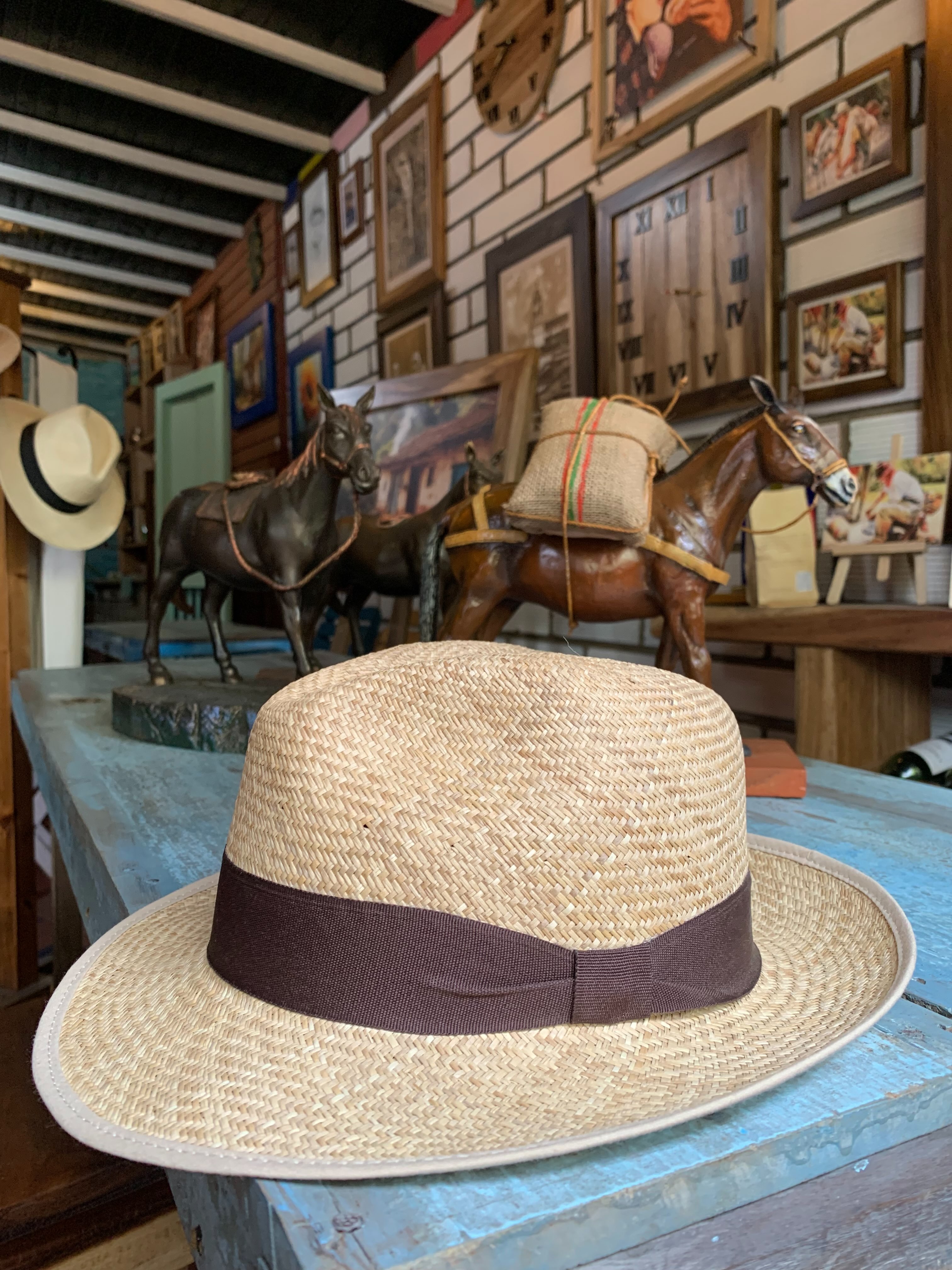
Woven by hand in Aguadas, Caldas
Every sombrero aguadeño starts as a plant, passes through many hands and makes its way to you. This is the story of that journey, the town where it begins and the people who keep it alive.
The town
Aguadas is a municipality in northern Caldas, Colombia. It belongs to the Heritage Towns of Colombia network and to the Coffee Cultural Landscape, which UNESCO named a World Heritage Site in 2011.
The sombrero aguadeño has been woven here for generations. It holds a denomination of origin, a recognition that ties its quality to the place and to the people who make it.
Aguadas is also known as the capital of the pasillo, a traditional Colombian music genre. Every August it hosts the National Pasillo Festival.
- Sombrero Aguadeño denomination of origin, Colombian Superintendence of Industry and Commerce
- Heritage Town of Colombia
- Home of the National Museum of the Sombrero Aguadeño
The iraca
Iraca (Carludovica palmata) looks like a palm, though it is not a true one. It grows from Central America to Bolivia, and its fiber is soft, flexible and durable.
Hats are made from the cogollo, the young leaf that is still closed. Only part of the plant ends up as straw for weaving.
Hats are graded by straw thickness as corriente, fino and extrafino. The thinner the fiber, the finer the weave and the more valuable the hat.
The process
Getting from plant to hat is slow work, done by hand in several stages.
Cutting
The iraca shoots are cut while the young leaves are still closed.
Splitting
By hand and with a small tool, the outer parts are removed and the leaf is split into thin strips. This is the work of the ripiadores.
Cooking
The strips are cooked in water for hours and then tied in bundles, a step known as ensartado.
Drying and whitening
The straw dries in the shade, is whitened with sulfur smoke and finishes drying in the sun.
Weaving
The weaver starts at the center of the crown and works round by round out to the brim.
Finishing
In the workshop, flaws are trimmed, the hat is pressed into shape, the brim is sewn and the ribbon is added.
A corriente hat can take around a week. An extrafino can take several months.
The people
Behind every hat there is a chain of crafts: those who grow and cut the iraca, those who split and prepare it, the weavers, and the workshops that shape and finish each piece.
Women and men in Aguadas have woven iraca for generations, and the craft has been passed down within families. Some weavers are the fourth generation of women weavers in their family.
Today the craft faces a challenge: fewer young people are learning to weave, and workshops say most artisans are now elderly.
Our intention
We want to work directly with families and workshops in Aguadas, pay a fair price for work that takes days or months, and tell you who made your hat. It is a commitment we are building with our suppliers, not a seal or a certification.
How your purchase helps
- You give value to a craft that needs a new generation and markets that pay it well.
- You take home a product with a denomination of origin, made in its place by its people.
- Wholesale orders for shops in Colombia and Europe aim to give workshops steadier work.
Bring home a piece of Aguadas
Choose your hat in the shop, or write to us if you want to buy for your business.